Exhibit A
An evidence engine for code that is only allowed to speak with proof.
Every claim it makes is a rerunnable test: red on the bug, green on the fix. When it cannot prove one, it stays silent. Every proof it produces is also open data for AI-for-software-engineering (AI4SE) research.
The problem
AI code reviewers have a trust problem. They cry wolf. A bot that flags ten “issues” with eight of them noise trains developers to skim past all ten, and the one real bug ships. The failure mode is not missing bugs. It is alert fatigue that collapses trust in the tool. Every mainstream reviewer optimizes for catch rate and reports a confidence score. Confidence is not proof. A 90%-confident wrong comment is still a wrong comment.
The idea
Exhibit A inverts the contract. It is governed by one rule: it may only report a bug if it can hand you a runnable test that fails on the broken code and passes on the fix. No proof, no comment. When it cannot prove a suspicion, it stays silent and records why.
This is enforced by construction rather than by a threshold. A deterministic, model-free flip check is the sole judge of what counts as evidence, and it trusts execution logs over anything the model claims. The result is a reviewer whose every statement is backed by an artifact you can re-run in seconds, and whose silence is a feature rather than a failure.
The same discipline produces a second output. Because every proof is an execution-validated fail-to-pass test tied to a specific commit, each one is a ready-made benchmark instance. Exhibit A doubles as a minting press for the contamination-free datasets that AI4SE research needs, and it emits research-grade artifacts as a byproduct of doing its day job.
Two modes, one engine
| Mode | Input | Output |
|---|---|---|
| Detective | A stack trace, error, or bug report plus a repo | An autonomously reproduced, verified fail-to-pass test |
| Prosecutor | A pull request | A review comment only when a flip is proven |
Both run on the shared Evidence Engine:
claim + code state(s)
    -> hypothesize (Codex / GPT-5.6, read-only)
    -> generate candidate test (pass-then-invert)
    -> execute both states in a sandbox
    -> FLIP CHECK  (deterministic, no model)
    -> VERIFIED Case File   or   UNCERTAIN (Silence Log)
See it run
A real provider investigation
This current-code run checks the existing suite, asks the configured provider for a test,
observes five matching failures on the reported state and a pass on the fixed state,
minimizes the evidence, and ends VERIFIED. The first candidate cleared the gate, so this
particular run had no rejection or retry.
Command: /opt/homebrew/bin/python3 -m exhibit_a.cli repro /tmp/ea/t --fixed /tmp/ea/b
--claim 'stock_for should return 0 for a missing SKU, not KeyError' --expect KeyError --out
/tmp/ea/c --no-sandbox --events. The two inputs were byte-for-byte temporary copies of
the checked-in inventory fixtures. One provider wait is capped at 15 seconds in playback;
the only tail trim removes output after the real verdict, before the final Case JSON. No
events were rewritten, reordered, or spliced. See the capture record.
The web case file
The video is one continuous final minute of a genuine 108.5-second SSE investigation at
http://127.0.0.1:3000/. A deliberately incorrect claim is tested five times against two
identical fixture states. It fails on both, so the deterministic judge rejects it as
fail-to-fail; the provider offers no refined candidate, and the UI ends UNCERTAIN with a
Silence Log. There is no retry to show because none happened.
Capture input: claim stock_for should return one for an unknown SKU instead of zero,
with both reported and fixed paths set to fixtures/sandbox_smoke. The first 48.5 seconds
of initial provider wait were trimmed; the published 59.93 seconds have no internal cut,
splice, reordered frame, narration, or audio track. See the capture record.
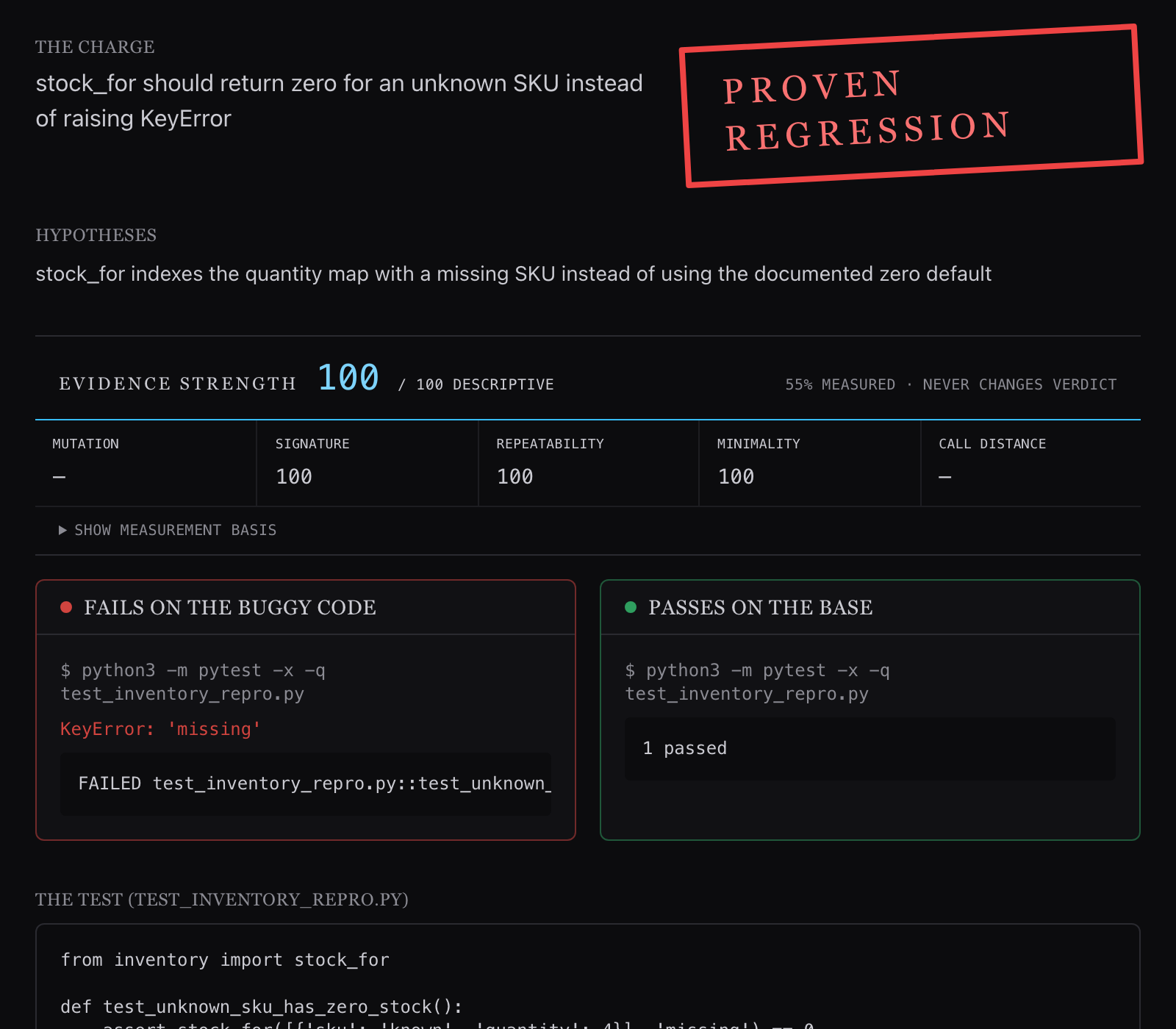
The still is a separate real run of the UI’s Replay proof action at
http://127.0.0.1:3100/ from a production build, using the checked-in
inventory_proven.json sealed Case. It is a no-execution replay for inspecting the
finished case-file layout, not a frame from the live investigation above.
What it proves, and what it does not
The flip check proves that behavior changed between two states. It does not prove the change is a bug, since most changes are intentional. A separate intent step labels a proven change as a regression or an expected one, and that label never overrides the execution result.
Verdicts are tiered so the tool never overclaims:
| Verdict | Meaning |
|---|---|
VERIFIED |
Fails on the broken code, passes on the fix. A full flip. |
PARTIAL |
A deterministic, signature-matched failure with no known-good state to compare against. |
FAILED |
Reserved for deterministic evidence that disproves the stated goal; the bug-repro judge does not emit it yet. |
UNCERTAIN |
Nothing cleared the gate. Honest silence. |
Scope: deterministic functional bugs in Python repos that build in a sandbox. It cannot speak to race conditions, performance regressions, or most security issues, and it stays silent instead of guessing.
Open science
The evidence discipline that makes Exhibit A trustworthy also makes it a data engine. Every verified Case is an execution-validated fact about real code, and the project turns those facts into open research assets.
- Contamination-free benchmarks. Each
VERIFIEDCase carries a commit SHA, a fail-to-pass test, and a date, which is exactly the shape of a SWE-bench-style instance. Because instances are minted continuously from live fixes and tagged by date, they can be filtered against any model’s training cutoff, so the benchmark does not rot into the training set. - Signed, replayable evidence bundles. A Case can be exported as a self-contained bundle (pinned commits, the test, the run command, logs, and content hashes) that anyone can re-execute and verify offline. See the Executable Evidence Format.
- Negative results as a dataset. The Silence Ledger records what the engine suspected but could not prove. Nobody publishes what reproduction tools fail to reproduce, which makes this a genuinely novel research asset. See Private research assets.
- Auditing the benchmarks themselves. The same mutation machinery measures how strong a benchmark’s own tests are, which surfaces the weak-oracle problem in existing suites. See the Oracle-gap probe.
Datasets are released under CC-BY-4.0 with a per-instance SPDX license tag, and bundles are built to be mirrored to a DOI-bearing archive for artifact evaluation.
Architecture
A monorepo with a hard boundary between the model that proposes and the judge that admits. The model is fallible. The judge is deterministic.
engine/                         Python, the Evidence Engine
  exhibit_a/
    models/case.py              the Case data model (shared contract, mirrored in TS)
    hypothesis/generator.py     the model seam where Codex/GPT-5.6 plugs in
    hypothesis/intent.py        separate, fallible intent judge (never gates evidence)
    executor/                   swappable sandbox: docker_exec (real), local_exec (dev)
    verdict/flip_check.py       PURE, DETERMINISTIC admissibility gates, the sole judge
    verdict/...                 mutation scoring, minimization, evidence strength (scores, not gates)
    engine.py                   orchestrator
    cli.py                      the exhibit-a CLI
web/                            Next.js 15, React 19, Tailwind, the "case file" UI
  src/app/api/investigate/...   drives the engine, streams each run over SSE
fixtures/                       tiny buggy/fixed repo pairs for offline runs
Security posture: untrusted repos and PR text are assumed hostile.
- Executors run against a disposable copy of the checkout, so source is never mutated.
- Runs are containerized by default; host execution is an explicit
--no-sandboxopt-in, and the web API never offers the choice. - Docker runs are network-off, capability-dropped,
no-new-privileges, read-only rootfs. - All untrusted input (repo URL, SHAs, claim text, model-generated patches) reaches
gitand shells as argv only, never string-interpolated, nevershell=True. - Remote intake is HTTPS-only, SHAs are hex-validated, and git hooks are disabled.
- Candidate run-commands are gated to a single scoped pytest file before execution.
Setup
Just evaluating? Every artifact above needs only a browser. Replaying a sealed Case needs Python, but neither Docker nor a model.
For a full local run: Python 3.11+, Node 18+ for the web UI, and Docker for sandboxed
execution. --no-sandbox trades containment for host execution and is only for checkouts
you trust.
# Engine
cd engine
pip install -e ".[dev,public-signatures]"   # public-signatures adds the Ed25519 backend
python3 -m pytest -q             # proves the flip check and verdicts end to end

# Web UI
cd web
npm install
export EXHIBIT_A_API_TOKEN=$(openssl rand -hex 24)   # required; routes are inert without it
export EXHIBIT_A_LOCAL_ROOT=$(cd .. && pwd)          # optional; enables local-path intake
npm run dev                      # http://localhost:3000
Usage
cd engine

# 1) Run a live investigation against local buggy/fixed checkouts
python3 -m exhibit_a.cli repro ../fixtures/buggy_inventory \
  --fixed ../fixtures/fixed_inventory \
  --claim "stock_for should return zero for an unknown SKU instead of raising KeyError" \
  --expect KeyError --json --no-sandbox

# 2) A real repository at two commits (base is buggy, fix is the fixing commit or PR head)
python3 -m exhibit_a.cli repro https://github.com/org/repo.git \
  --base-sha <buggy-sha> --fix-sha <fix-sha> \
  --claim "describe the regression" --json

# 3) Deterministic replay of a sealed, known-good Case (no model, no execution)
python3 -m exhibit_a.cli repro --replay ../fixtures/cases/inventory_proven.json --json
--no-sandbox appears only on the in-repo fixtures: they are trusted, and carry no
lockfile for the pinned-image path to build from. Real repositories run sandboxed.
How Codex and GPT-5.6 were used
Codex with GPT-5.6 Sol is both the thing this was built with and a first-class component of the product.
- As a product component, the hypothesis generator. Inside the engine, Codex runs in a
read-only sandbox and does exactly one job. It localizes, plans, drafts a passing test,
inverts it to fail-on-bug (pass-then-invert), and refines on execution feedback. It
proposes reproductions. It never decides a verdict. The deterministic flip check alone
admits a Case as
VERIFIED, from execution logs, so the product’s honesty guarantee holds regardless of how the model behaves. This model-versus-judge split is the core design. - As the implementation partner. Codex was the pair-programmer for the engine, the security boundaries, the test suite, and the streaming UI, with every change gated behind the same tests and lint the CI runs.
The division of labor mirrors the product’s own thesis. The model reasons, but only execution is allowed to speak.
Status
This is a working, verified system. The engine and typed web test suites are green in CI, which runs engine lint, format, and tests alongside the web build. The deterministic verdict core, Docker sandboxing, two-SHA git intake, git-bisect culprit attribution, mutation scoring, evidence minimization, Prosecutor review of a pull request inside an environment the caller supplies, and a full research-instrumentation layer are implemented and tested.
Working is not the same as broadly capable, and the measured position belongs here rather
than only in the README. On the latest preregistered, repository-disjoint corpus, running
on linux/arm64, the deterministic judge was reached on 15 of 30 real fixes and proved 9
of them. Environment construction rather than the judge is the binding constraint: of the
judged candidates, 9 of 15 verified. Results are scoped to their recorded platform, and a
later provider-free probe of the same corpus on x86_64 reached the judge on 24 of 30,
so the published figure is a floor rather than a platform-independent measurement. See
the coverage results.
What has not been measured is the other half of the claim. The product’s argument is that silence is a feature, and no study has yet asked how often the engine speaks about a change that declares it changed nothing. A corpus for that is frozen and unrun.